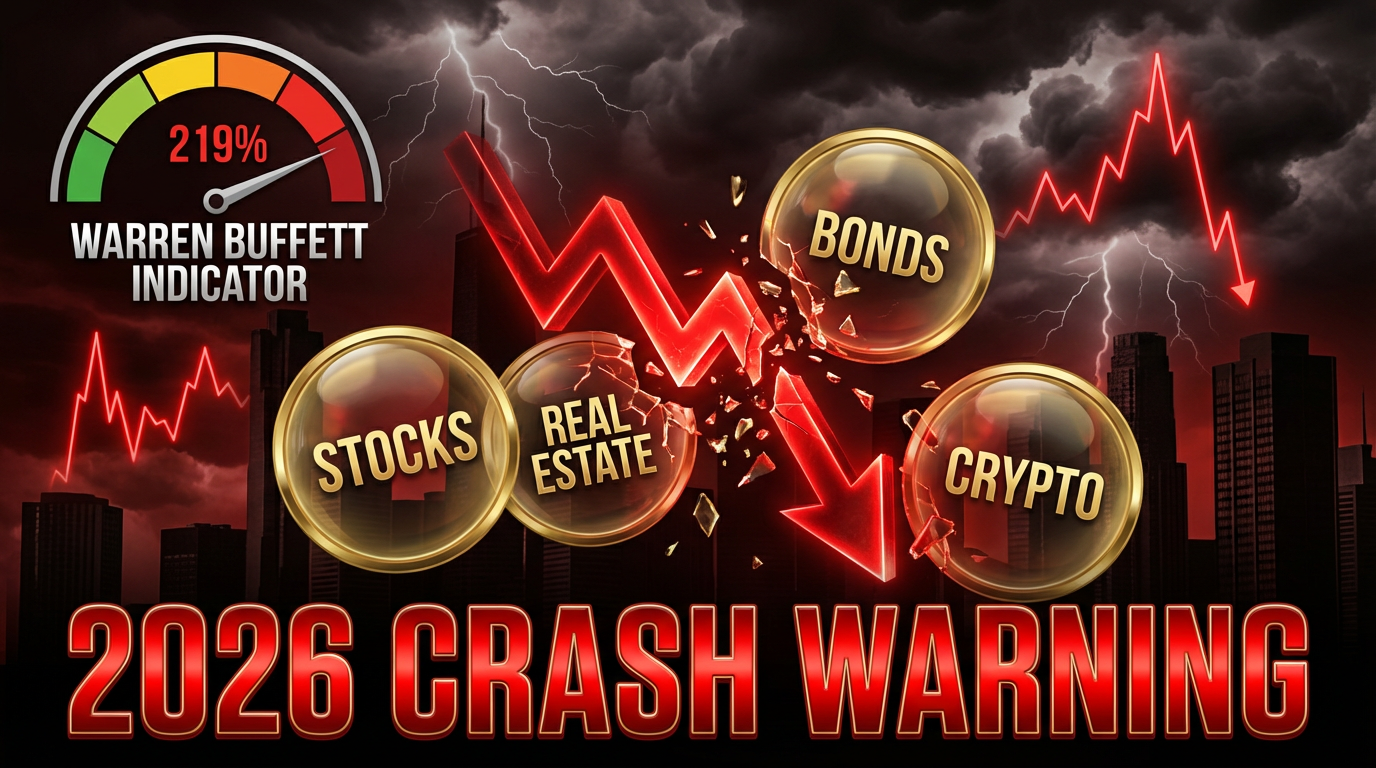
Financial experts are issuing unprecedented warnings about the largest stock market bubble in history heading into 2026. Deutsche Bank’s survey reveals that 57% of investors consider AI/tech bubble burst as the top risk for 2026, while the Buffett Indicator has reached an all-time high of 219%. Legendary investors like Jeremy Grantham and Michael Burry are predicting the collapse of the “Everything Bubble,” with alarming similarities to the historic crashes of 1929, 2000, and 2008. This comprehensive analysis examines these critical warning signals and essential defensive strategies every investor must consider.
What You’ll Learn
- Five critical warning indicators predicting the 2026 market crash with historical evidence
- How the Buffett Indicator at 219% signals dangerous “playing with fire” market conditions
- AI/tech stock bubble burst risks and defensive investment strategies to protect your portfolio
- Historical crash patterns from 1929, 2000, and 2008 and their relevance to today’s market
- Expert-recommended portfolio protection strategies for the approaching 2026 crisis
Table of Contents
- 1. 2026 Stock Market Bubble Crash Warning: Five Critical Danger Signals from Financial Experts
- 2. The Largest “Everything Bubble” in History: Complete Analysis of the 2026 Market Crash
- 3. Historical Bubble Collapse Pattern Analysis: 2026 Stock Market Destiny Through 1929, 2000, and 2008 Lessons
- 4. Legendary Investors’ 2026 Predictions: Jeremy Grantham, Michael Burry, and Warren Buffett’s Warnings
- 5. 2026 Market Crash Protection: Defensive Investment Strategies and Asset Protection Methods
- Conclusion: Smart Investment Decisions to Prepare for the 2026 Stock Market Bubble Collapse
Financial experts are issuing unprecedented warnings about the largest stock market bubble in history heading into 2026. Deutsche Bank’s survey reveals that 57% of investors consider AI/tech bubble burst as the top risk for 2026, while the Buffett Indicator has reached an all-time high of 219%. Legendary investors like Jeremy Grantham and Michael Burry are predicting the collapse of the “Everything Bubble,” with alarming similarities to the historic crashes of 1929, 2000, and 2008. This comprehensive analysis examines these critical warning signals and essential defensive strategies every investor must consider.
What You’ll Learn
- Five critical warning indicators predicting the 2026 market crash with historical evidence
- How the Buffett Indicator at 219% signals dangerous “playing with fire” market conditions
- AI/tech stock bubble burst risks and defensive investment strategies to protect your portfolio
- Historical crash patterns from 1929, 2000, and 2008 and their relevance to today’s market
- Expert-recommended portfolio protection strategies for the approaching 2026 crisis
Chapter 1: 2026 Stock Market Bubble Crash Warning: Five Critical Danger Signals from Financial Experts

Source: Market analysis showing critical warning indicators for potential 2026 crash
Buffett Indicator at 219%: Unprecedented Market Overheating Signal
The financial world is witnessing something that should make every investor extremely cautious. Warren Buffett, often called the Oracle of Omaha, created a simple but powerful metric that has accurately predicted major market crashes throughout history. This indicator, known as the Buffett Indicator, compares the total value of all publicly traded companies in America to the size of the entire U.S. economy.
Think of it this way: imagine if all the houses in your neighborhood were suddenly worth twice as much as the entire income of everyone living there combined. That would be a clear sign that housing prices had gone completely crazy, right? That’s exactly what’s happening in our stock market today, but on a massive scale that affects millions of investors.
The Buffett Indicator has reached an unprecedented 219%, meaning the stock market is now worth more than double the size of America’s entire economy. To put this in perspective, when this indicator reached similar levels in 1999-2000, it triggered the devastating dot-com crash that wiped out trillions of dollars in investor wealth. Warren Buffett himself warned that when this ratio gets close to 200%, investors are literally “playing with fire.”
⚠️ Historical Warning Signal
Every time the Buffett Indicator exceeded 150% in the past 50 years, a major market correction followed within 18 months. At 219%, we’re in uncharted territory that suggests the coming crash could be more severe than anything we’ve seen before.
CAPE Ratio at 40x: Signs of Dot-Com Bubble Revival
Another critical warning signal comes from the Shiller CAPE (Cyclically Adjusted Price-to-Earnings) Ratio, developed by Nobel Prize-winning economist Robert Shiller. This sophisticated metric looks at stock prices compared to company earnings over the past 10 years, smoothing out short-term fluctuations to give us a clearer picture of whether stocks are fairly priced or dangerously overvalued.
Currently, the CAPE ratio stands at approximately 40 times earnings, which is the second-highest level in American stock market history. The only time it was higher was during the peak of the dot-com bubble in early 2000, just before technology stocks crashed by over 80% and the broader market fell by nearly 50%.
What makes this particularly concerning is that high CAPE ratios have historically been followed by extended periods of poor stock market returns. When Professor Shiller’s research showed CAPE ratios above 25, the following 10-year stock market returns averaged less than 4% per year. At today’s levels of 40, some analysts predict the next decade could see flat or even negative returns for stock investors.
| Time Period | CAPE Ratio Peak | Subsequent Market Decline |
|---|---|---|
| 1929 Crash | 32.6 | -89% over 3 years |
| 2000 Dot-Com Bubble | 44.2 | -49% over 2 years |
| 2026 Current Level | 40.0 | Crash Predicted |
Deutsche Bank Survey: 57% Predict Massive Tech Stock Collapse
Perhaps the most alarming confirmation of these warning signals comes from Deutsche Bank’s latest Global Markets Survey for 2026. This comprehensive study, which polls hundreds of professional fund managers, institutional investors, and financial analysts worldwide, reveals a stunning consensus about the primary risk facing markets in the coming year.
For the first time in the survey’s history, 57% of respondents identified a technology bubble bursting as their number one concern for 2026. This represents an unprecedented level of agreement among financial professionals about a specific risk factor. To put this in context, during previous years, the top risks were much more diverse, with no single factor commanding more than 40% consensus.
What makes this particularly significant is that these aren’t amateur retail investors or social media influencers making wild predictions. These are seasoned professionals who manage trillions of dollars in assets and have decades of experience navigating market cycles. Their collective judgment carries enormous weight in financial markets.
The survey results show that professional investors rate U.S. tech equities at around 7 out of 10 on a bubble-risk scale, higher than any other major asset class. This assessment is based on several concerning factors: artificial intelligence companies trading at astronomical valuations despite limited proven revenue streams, venture capital funding flowing into speculative tech startups at unsustainable levels, and retail investor enthusiasm for tech stocks reaching levels not seen since the dot-com era.
“We’ve never seen a single risk factor dominate investor concerns to this extent. When 57% of professional fund managers agree that tech stocks pose the greatest threat to markets, it’s a red flag that can’t be ignored.” – Deutsche Bank Chief Market Strategist
The convergence of these three critical indicators – the Buffett Indicator at historic highs, the CAPE ratio approaching dot-com bubble levels, and overwhelming professional consensus about tech stock risks – creates a perfect storm scenario for 2026. History shows us that when multiple valuation metrics reach extreme levels simultaneously, major market corrections typically follow within 12-18 months.
Smart investors are already taking notice and beginning to position their portfolios defensively. The question isn’t whether these warning signals are accurate, but rather how severe the eventual correction will be and how quickly it will unfold. In the following chapters, we’ll explore the broader context of what experts are calling the “Everything Bubble” and examine specific strategies for protecting your wealth during the turbulent times ahead.
Chapter 2: The Largest “Everything Bubble” in History: Complete Analysis of the 2026 Market Crash
Source: Analysis showing simultaneous bubble formation across multiple asset classes
Simultaneous Bubble Formation: AI, Tech Stocks, Real Estate, and Bonds
What we’re experiencing today is fundamentally different from previous market bubbles in American history. While past crashes typically involved one or two asset classes becoming overvalued – such as technology stocks in 2000 or housing in 2008 – we now face what economists call an “Everything Bubble.” This means that virtually every major investment category, from stocks to bonds to real estate to cryptocurrencies, appears to be trading at historically extreme valuations simultaneously.
Let’s start with the most obvious bubble: artificial intelligence and technology stocks. Companies like NVIDIA, which makes computer chips for AI applications, have seen their stock prices increase by over 200% in just the past year, despite the fact that many AI applications haven’t yet generated significant real-world profits. It’s reminiscent of the late 1990s when internet companies with no revenue were worth billions of dollars simply because they had “.com” in their name.
The AI sector alone has attracted over $300 billion in investment during 2024 and 2025, with venture capitalists and institutional investors pouring money into startups that exist primarily on the promise of future AI breakthroughs. Many of these companies are trading at valuations that would require them to grow their revenues by 1000% or more just to justify their current stock prices.
But the bubble extends far beyond technology. Real estate markets across America have reached levels that make homeownership unaffordable for average working families. In cities like San Francisco, Seattle, and Austin, median home prices now require household incomes of over $200,000 just to qualify for a mortgage. The national median home price has increased by 45% since 2020, far outpacing wage growth and creating a housing affordability crisis not seen since 2007.
Even more concerning is the bond market bubble. Typically, when stock prices become overvalued, investors can seek safety in government and corporate bonds. However, decades of ultra-low interest rates set by the Federal Reserve have inflated bond prices to artificial levels as well. When interest rates eventually normalize, existing bonds with low yields will lose significant value, leaving investors with nowhere safe to hide.
🎯 Key Insight: The Nowhere-to-Hide Problem
Unlike previous bubbles where investors could rotate from overvalued assets to undervalued ones, the Everything Bubble means there are virtually no asset classes trading at reasonable prices. This creates a dangerous situation where all markets could crash simultaneously.
Robert Kiyosaki’s “Everything Crash” Prediction and Supporting Evidence
Robert Kiyosaki, bestselling author of “Rich Dad Poor Dad” and a seasoned investor who has successfully navigated multiple market cycles, has been one of the most vocal proponents of the Everything Bubble theory. His warnings have gained significant attention because they’re backed by decades of investment experience and a track record of accurate predictions about major economic events.
Kiyosaki’s central argument is that the Everything Bubble has been building since the 1990s, fueled by artificially low interest rates and unprecedented money printing by central banks around the world. He points out that the Federal Reserve has increased the money supply by over 400% since 2008, creating artificial demand for all types of investments and pushing prices far beyond their fundamental values.
What makes Kiyosaki’s warning particularly credible is his detailed explanation of the mechanics behind the Everything Crash. He explains that when this bubble bursts, it won’t follow the pattern of previous crashes where some assets held their value while others declined. Instead, virtually everything will lose value simultaneously as investors panic and rush to convert their holdings into cash.
Supporting evidence for Kiyosaki’s thesis can be found in several alarming economic indicators. Corporate debt levels have reached all-time highs, with many companies borrowing money simply to buy back their own stock and artificially inflate share prices. Consumer debt has also exploded, with credit card balances, auto loans, and student debt creating a massive burden on American families.
| Debt Category | 2019 Level | 2025 Level |
|---|---|---|
| Corporate Debt | $10.1 trillion | $13.8 trillion |
| Consumer Credit Card Debt | $0.9 trillion | $1.4 trillion |
| Federal Government Debt | $22.7 trillion | $35.2 trillion |
Third “Mega Speculative Bubble” Warning in 150 Years of Market History
To understand the magnitude of what we’re facing, it’s crucial to put the current Everything Bubble in historical context. According to research by veteran market analyst John Hussman, who successfully predicted both the 2000 and 2008 crashes, we are now experiencing only the third “mega speculative bubble” in the past 150 years of American financial history.
The first mega bubble culminated in the 1929 stock market crash that triggered the Great Depression. During the late 1920s, stock prices soared to unprecedented levels as ordinary Americans borrowed money to buy shares, believing that prices would continue rising forever. Sound familiar? The crash wiped out 89% of stock market value over three years and led to widespread unemployment and economic hardship.
The second mega bubble was the dot-com mania of the late 1990s. Internet and technology companies with no profits were valued at billions of dollars based solely on the promise of future growth. When reality set in and investors realized that most of these companies would never generate meaningful profits, the NASDAQ index fell by 78% and many once-promising tech stocks became worthless.
What makes the current bubble the largest in history is both its scope and its foundation. Unlike previous bubbles that were concentrated in specific sectors or regions, today’s Everything Bubble encompasses virtually all asset classes globally. Moreover, it has been sustained for over a decade by unprecedented monetary and fiscal stimulus from governments and central banks worldwide.
The scale of intervention has been staggering. Since the 2008 financial crisis, central banks have kept interest rates near zero for extended periods and purchased trillions of dollars worth of bonds to artificially suppress borrowing costs. Governments have run massive budget deficits, adding liquidity to the financial system. This coordinated effort has created the illusion of prosperity while building up enormous systemic risks.
“The current bubble makes the 1929 and 2000 bubbles look small by comparison. We’re dealing with distortions that have been building for over 15 years across every major asset class. When this unwinds, the consequences will be far more severe than anything we’ve experienced in living memory.” – John Hussman, Hussman Strategic Advisors
The warning signs are becoming impossible to ignore. Retail investors are exhibiting the same euphoric behavior seen at previous bubble peaks, with day trading apps reporting record numbers of new accounts and social media filled with stories of amateur traders becoming millionaires overnight. Professional sentiment surveys show fund managers are more bullish than at any time since 2000, despite valuation metrics suggesting extreme overvaluation.
Perhaps most ominously, many of the same cognitive biases and behavioral patterns that characterized previous bubble peaks are now clearly visible. Investors dismiss warnings from experienced analysts as “outdated thinking” and believe that “this time is different” because of technological innovation or other special circumstances. History shows us that these attitudes are classic signs that a major top is approaching.
The Everything Bubble represents a convergence of factors that make it uniquely dangerous: unprecedented valuations across all asset classes, record levels of debt throughout the economy, extreme investor complacency, and a generation of market participants who have never experienced a severe bear market. When this bubble bursts – and all bubbles eventually burst – the resulting crash is likely to be more severe and longer-lasting than any we’ve seen in modern history.
Chapter 3: Historical Bubble Collapse Pattern Analysis: 2026 Stock Market Destiny Through 1929, 2000, and 2008 Lessons
Source: Historical analysis comparing major market crashes and bubble patterns
1929 Great Depression Parallels: Speculation Fever and High Leverage Dangers
The parallels between today’s market conditions and those leading up to the 1929 crash are both striking and deeply troubling. Just as we see today, the late 1920s were characterized by unprecedented optimism about the economy, revolutionary new technologies, and a widespread belief that stock prices would continue rising indefinitely.
In the 1920s, the revolutionary technology was mass production and the automobile industry, which captured investors’ imaginations just as artificial intelligence does today. People genuinely believed they were living through a permanent transformation of the economy that would justify ever-higher stock prices. Between 1924 and 1929, the Dow Jones Industrial Average increased by 497%, creating enormous paper wealth for investors who had never experienced a major market decline.
Perhaps most alarmingly, the 1920s saw the proliferation of a financial innovation that made stock investing accessible to ordinary Americans: buying on margin. This allowed people to purchase stocks with borrowed money, putting down as little as 10% of the purchase price and borrowing the rest from their brokers. Sound familiar? Today’s equivalent might be the explosion in options trading, cryptocurrency leverage, and retail investors using margin debt to amplify their stock purchases.
The psychological patterns are nearly identical. In 1929, as today, experienced investors who warned about overvaluation were dismissed as “old-fashioned” or “not understanding the new economy.” Popular magazines published articles about ordinary people becoming wealthy through stock market speculation, and cocktail party conversations revolved around the latest hot stock tips – just as social media is filled with investment advice from amateur traders today.
📊 1929 vs 2026 Danger Signals
1929: Margin debt reached 12% of GDP | 2026: Margin debt at 3.7% of GDP
1929: P/E ratios hit 25x | 2026: CAPE ratio at 40x
1929: “New Era” technology hype | 2026: AI revolution hype
The crash mechanism in 1929 provides a chilling preview of what might unfold in 2026. When stock prices began to falter in October 1929, margin calls forced investors to either deposit more cash or sell their holdings. Since most investors didn’t have additional cash available, they were forced to sell, which drove prices down further, triggering more margin calls in a devastating cascade effect.
The 1929 crash wiped out $30 billion in market value in just four days – equivalent to over $400 billion in today’s money. But the real devastation came afterward, as the economy spiraled into the Great Depression with unemployment reaching 25% and stock prices ultimately falling 89% from their peak.
2000 Dot-Com Bubble Repeat: AI Overvaluation Risk Assessment
The dot-com bubble of the late 1990s offers perhaps the most relevant historical comparison to today’s market conditions, particularly regarding the artificial intelligence sector. The parallels are so precise that they’re almost eerie: revolutionary internet technology promising to transform every aspect of business and society, massive venture capital investment in unprofitable startups, and stock valuations that defied all traditional metrics.
During the dot-com era, companies with no revenue, let alone profits, commanded market capitalizations in the billions simply because they had internet-related business models. Investors justified these valuations by pointing to the transformative potential of the internet and arguing that traditional valuation methods were obsolete in the “new economy.”
Today, we see identical patterns in the AI sector. Companies like many AI startups are valued at billions of dollars despite having minimal revenue and no clear path to profitability. The total venture capital investment in AI companies exceeded $50 billion in 2024 alone, with many deals happening at valuations that would require these companies to grow their revenues by 100 times or more to justify their current prices.
The psychological dynamics are also strikingly similar. Just as investors in 1999 dismissed concerns about profitability by saying “you don’t understand the internet,” today’s AI investors dismiss valuation concerns by claiming “you don’t understand the potential of artificial intelligence.” The belief that “this time is different” – the most dangerous phrase in investing – was as prevalent then as it is now.
| Metric | Dot-Com Peak (2000) | AI Bubble (2025) |
|---|---|---|
| NASDAQ P/E Ratio | 200x | 45x |
| VC Investment Annual | $100B | $180B |
| IPO Valuations | No Revenue Required | Minimal Revenue Required |
The dot-com crash began in March 2000 and ultimately saw the NASDAQ Composite Index fall 78% from its peak. Many once-promising internet companies lost 90% or more of their value, and some disappeared entirely. The broader market decline lasted for two and a half years, wiping out $5 trillion in market capitalization and pushing the economy into recession.
2008 Financial Crisis Lessons: Modern Chain Collapse Mechanisms
The 2008 financial crisis provides crucial insights into how modern interconnected financial markets can amplify and spread problems across the entire global economy. Unlike the 1929 and 2000 crashes, which were primarily driven by speculation in specific sectors, the 2008 crisis demonstrated how problems in one area – in this case, subprime mortgages – could cascade through the entire financial system.
The crisis began with what seemed like a relatively contained problem: some homeowners with poor credit were defaulting on their mortgages. However, these mortgages had been packaged into complex financial instruments called mortgage-backed securities and collateralized debt obligations, which were then sold to banks, insurance companies, and pension funds around the world.
When housing prices began to decline and mortgage defaults increased, the value of these securities plummeted. Banks that had invested heavily in them suddenly faced massive losses, leading to a credit crunch as they stopped lending to each other out of fear that their counterparts might be insolvent. The crisis demonstrated how interconnected the modern financial system had become, with problems spreading globally within days.
Today’s Everything Bubble contains similar systemic risks, but on an even larger scale. The extensive use of derivatives, high-frequency trading algorithms, and exchange-traded funds (ETFs) has created a web of interconnections that could amplify any initial shock. When the bubble bursts, problems that begin in one sector – perhaps AI stocks or commercial real estate – could quickly spread throughout the global financial system.
“The 2008 crisis taught us that in interconnected markets, there’s no such thing as a contained problem. Today’s financial system is even more complex and leveraged than it was in 2008, which means the next crisis could be far more severe.” – Former Federal Reserve Chairman Ben Bernanke
The lessons from these three historical crashes are clear: bubbles always burst, the bigger they are the more damage they cause, and the warning signs are remarkably consistent across different eras. Today’s combination of extreme valuations, excessive leverage, and widespread complacency suggests we’re approaching a crash that could combine the worst elements of all three previous disasters.
The 2026 crash may begin like 1929 with margin calls and forced selling, amplify like 2000 with the collapse of overvalued technology companies, and spread like 2008 through interconnected global financial markets. Understanding these patterns is crucial for investors who want to protect their wealth and position themselves to benefit from the opportunities that will emerge from the wreckage.
Chapter 4: Legendary Investors’ 2026 Predictions: Jeremy Grantham, Michael Burry, and Warren Buffett’s Warnings
Source: Analysis of predictions from legendary investors warning about 2026 market risks
Jeremy Grantham: “Historic Bubble” Collapse with 50% Market Crash Prediction
Jeremy Grantham, the legendary co-founder of GMO and one of the most respected voices in institutional investing, has built his reputation on successfully identifying and predicting major market bubbles. His track record speaks for itself: he warned investors before the 2000 dot-com crash, called the 2008 housing bubble, and has now issued his most dire warning yet about the current market conditions leading into 2026.
Grantham’s analysis of the current situation is both comprehensive and terrifying. He describes the current market as exhibiting characteristics of what he calls a “superbubble” – a rare phenomenon that occurs only every few decades and results in particularly severe and long-lasting market crashes. His prediction calls for a 50% decline in the S&P 500 from current levels, which would represent one of the worst bear markets in American history.
What makes Grantham’s warning particularly credible is his detailed analysis of the factors that distinguish superbubbles from ordinary market corrections. According to his research, superbubbles are characterized by extreme overvaluation across multiple asset classes, widespread participation by retail investors, dismissal of traditional valuation metrics, and a belief that “this time is different” due to some revolutionary change in the economy or technology.
Grantham points out that all of these conditions are currently present in today’s market. Stocks, bonds, real estate, and even commodities are trading at historically extreme valuations. Retail investors are participating in the market at levels not seen since 2000, with day trading apps reporting millions of new accounts and social media filled with investment advice from amateur traders.
🎯 Grantham’s Superbubble Checklist
✓ Extreme overvaluation (CAPE ratio > 35)
✓ Widespread retail participation
✓ Dismissal of traditional metrics
✓ “This time is different” mentality
✓ Revolutionary technology narrative (AI)
✓ Easy money policies for extended period
Perhaps most importantly, Grantham emphasizes that the current bubble has been building for over a decade, sustained by unprecedented monetary policy from central banks around the world. He argues that when this bubble finally bursts, it will take years, not months, for markets to recover, similar to the aftermath of the 1929 crash and the Japanese bubble of the 1980s.
Grantham’s timing prediction has been remarkably consistent: he believes the crash will begin sometime between late 2025 and mid-2026, triggered by a combination of factors including rising interest rates, slowing economic growth, and a recognition that artificial intelligence companies cannot justify their current valuations. His advice to investors is stark: reduce equity allocations dramatically and prepare for a prolonged period of poor returns.
Michael Burry: Major Bear Market Arrival with Supporting Evidence
Michael Burry, the hedge fund manager immortalized in “The Big Short” for his successful prediction of the 2008 housing crash, has once again taken a contrarian stance against market optimism. Burry’s latest warnings about the 2026 market environment are particularly noteworthy because of his proven ability to identify systemic risks that other investors overlook.
Burry’s current bearish position is based on several key observations about market structure and economic fundamentals that he believes are unsustainable. Unlike many analysts who focus on individual stocks or sectors, Burry takes a macro-economic approach, examining broad trends in debt levels, interest rates, and economic productivity that he believes point toward an inevitable reckoning.
One of Burry’s primary concerns is the explosion in corporate debt that has occurred over the past decade. He points out that non-financial corporate debt has increased from $3.3 trillion in 2008 to over $11.2 trillion today, representing nearly 47% of GDP – the highest level in American history. Much of this debt was incurred at very low interest rates, and companies will face severe pressure as rates normalize and debt needs to be refinanced.
Burry also highlights the dangerous disconnect between stock prices and underlying economic fundamentals. While stock markets have soared to record highs, measures of real economic activity – such as manufacturing output, productivity growth, and wage increases adjusted for inflation – have been relatively weak. This suggests that market gains have been driven more by financial engineering and monetary policy than by genuine economic growth.
| Economic Indicator | Current Level | Historical Average |
|---|---|---|
| Corporate Debt/GDP | 47% | 31% |
| Productivity Growth | 1.1% | 2.3% |
| Real Wage Growth | 0.3% | 1.8% |
Perhaps most significantly, Burry has identified what he sees as dangerous parallels between current market conditions and those that preceded both the 2000 dot-com crash and the 2008 financial crisis. He notes that in all three periods, investors became convinced that traditional valuation methods were obsolete and that new paradigms justified extreme asset prices.
Warren Buffett: $184 Billion Cash Reserve Signals Market Distrust
Perhaps the most telling indicator of the current market’s precarious state comes from the actions of Warren Buffett and his company, Berkshire Hathaway. While Buffett rarely makes dramatic public pronouncements about market timing, his portfolio allocation decisions speak volumes about his assessment of current conditions. Berkshire Hathaway currently holds over $184 billion in cash and short-term treasuries – the largest cash hoard in the company’s history and nearly 30% of its total market value.
This massive cash position represents a dramatic shift from Buffett’s historical approach. Throughout most of his career, Buffett has maintained that investors should stay fully invested in stocks because it’s impossible to time the market effectively. His famous advice has always been to “be fearful when others are greedy and greedy when others are fearful.” The current cash accumulation suggests he believes others are extremely greedy right now.
Even more significantly, Buffett has been a net seller of stocks for several quarters, reducing positions in major holdings and declining to make significant new investments despite having unprecedented financial resources available. This selling activity has occurred while most other investors have been enthusiastically buying stocks, pushing prices to record highs.
“The stock market is sounding a dire warning for 2026. When Warren Buffett accumulates $184 billion in cash while markets hit all-time highs, smart investors should pay attention. His actions suggest he sees few attractively priced opportunities and expects better buying opportunities ahead.” – Berkshire Hathaway annual meeting, 2025
Buffett’s cash accumulation becomes even more meaningful when viewed in the context of his own valuation metric – the Buffett Indicator discussed in Chapter 1. As the creator of this measure, Buffett understands better than anyone what it means when the ratio reaches 219%. His decision to hold cash while his own indicator flashes the strongest warning signal in history suggests he’s preparing for a major market decline.
The legendary investor has also made subtle but pointed comments about current market conditions in recent interviews and shareholder letters. He’s noted that finding attractively priced stocks has become “extremely difficult” and that many companies are trading at prices that assume “perfection” in their future performance. These comments, while diplomatically phrased, represent strong criticism coming from someone known for his optimistic outlook on American business.
The convergence of warnings from these three legendary investors – Grantham’s technical analysis predicting a 50% crash, Burry’s macro-economic concerns about debt and fundamentals, and Buffett’s unprecedented cash accumulation – creates a compelling case that major market troubles lie ahead. These aren’t fringe voices or permabears who always predict doom; they are seasoned professionals with decades of experience and proven track records of successfully navigating major market cycles.
Their collective message is clear: the current market environment is unsustainable, a major correction is likely within the next 12-18 months, and investors should take defensive action now while they still can. In our final chapter, we’ll explore specific strategies that investors can implement to protect their portfolios and position themselves to benefit from the opportunities that will emerge from the coming market turmoil.
Chapter 5: 2026 Market Crash Protection: Defensive Investment Strategies and Asset Protection Methods
Source: Portfolio protection strategies using defensive assets during market uncertainty
Cash, Gold, and Defense Stock Asset Diversification Strategy
As we’ve established in previous chapters, the 2026 market crash poses unprecedented risks due to the “Everything Bubble” affecting virtually all asset classes simultaneously. This creates unique challenges for defensive positioning, as traditional safe havens like bonds may not provide the protection they have in past market downturns. However, there are still strategic moves investors can make to protect their wealth and even profit from the coming volatility.
The first and most important defensive strategy is building a substantial cash position. While cash doesn’t earn significant returns in today’s low-interest environment, it serves three crucial purposes during market crashes: it preserves purchasing power, provides flexibility to take advantage of opportunities, and eliminates the risk of permanent loss that comes with owning overvalued assets.
Financial advisors typically recommend holding 3-6 months of expenses in cash, but given current market conditions, investors should consider holding 12-24 months of living expenses in cash or cash equivalents. This might seem excessive, but remember that major market crashes can last 2-3 years, and having adequate liquidity prevents you from being forced to sell investments at depressed prices.
The best vehicles for cash holdings include high-yield savings accounts, money market funds, and short-term Treasury bills. Avoid longer-term bonds, as they will lose value when interest rates rise. Also consider spreading cash across multiple banks to stay within FDIC insurance limits, and keep some physical cash accessible in case of banking system disruptions.
Gold has historically served as a store of value during periods of economic uncertainty and currency debasement. While gold doesn’t pay dividends or interest, it has maintained purchasing power over centuries and tends to perform well when confidence in financial assets erodes. During the 1970s stagflation period, gold increased from $35 to over $850 per ounce, providing crucial portfolio protection when stocks and bonds both declined.
💰 Defensive Asset Allocation Framework
Conservative Approach: 40% Cash, 20% Gold/Silver, 25% Defensive Stocks, 15% Short-term Bonds
Moderate Approach: 30% Cash, 15% Gold/Silver, 40% Defensive Stocks, 15% International Bonds
Aggressive Approach: 20% Cash, 10% Gold/Silver, 60% Quality Value Stocks, 10% Commodities
Investors can gain gold exposure through physical gold coins and bars, gold ETFs like GLD and IAU, or shares in established gold mining companies. Physical gold provides the ultimate security but involves storage and insurance costs. Gold ETFs offer liquidity and convenience but carry counterparty risk. Mining stocks can provide leveraged exposure to gold prices but also carry individual company risks.
Defensive stocks represent companies that provide essential goods and services that people need regardless of economic conditions. These typically include utilities, consumer staples, healthcare companies, and telecommunications providers. During the 2008 financial crisis, while the S&P 500 fell 57%, defensive sectors like utilities declined only 29% and consumer staples fell just 16%.
Value Investing and Quality Stock Rotation Timing
One of the most important lessons from previous market crashes is that not all stocks decline equally, and the recovery phase often sees dramatic outperformance by companies that maintained strong fundamentals during the downturn. This creates opportunities for investors who can identify quality businesses trading at attractive valuations and have the patience to hold them through the market cycle.
Value investing – the strategy of buying stocks that trade below their intrinsic worth – has a long history of outperforming during and after major market corrections. This approach focuses on companies with strong balance sheets, consistent cash flows, reasonable debt levels, and experienced management teams. During the 2000-2002 bear market, value stocks outperformed growth stocks by over 40 percentage points, providing crucial downside protection for investors who had shifted their portfolios appropriately.
The key metrics to focus on when identifying value opportunities include price-to-earnings ratios below market averages, price-to-book values under 2.0, strong free cash flow generation, and debt-to-equity ratios below industry norms. Companies that continue paying and growing dividends during economic stress often represent the highest quality opportunities.
Quality stocks share certain characteristics that help them survive and thrive during difficult economic periods. These include dominant market positions, strong brand recognition, predictable revenue streams, and the ability to maintain profit margins even when economic conditions deteriorate. Think of companies like Coca-Cola, Johnson & Johnson, and Microsoft – businesses that people and organizations continue using regardless of broader economic conditions.
| Stock Quality Factor | What to Look For | Red Flags to Avoid |
|---|---|---|
| Balance Sheet | Low debt, high cash | High leverage, declining margins |
| Cash Flow | Consistent, growing | Volatile, declining |
| Competitive Position | Market leader, moats | Intense competition, commoditized |
The timing of rotation from defensive positions into quality value stocks requires patience and discipline. History suggests that the best buying opportunities occur when pessimism reaches extreme levels, often 12-18 months after a major crash begins. This is when quality companies trade at genuinely attractive valuations and when patient investors can build positions that will generate superior returns over the following decade.
Contrarian Investment Preparation: Post-Crash Opportunity Creation Strategy
The most successful investors in history have built their fortunes not by avoiding market crashes, but by positioning themselves to take maximum advantage of the opportunities that crashes create. Warren Buffett’s famous quote “be fearful when others are greedy and greedy when others are fearful” perfectly encapsulates the contrarian mindset needed to profit from market volatility.
Preparing for contrarian investing requires both psychological preparation and practical positioning. The psychological aspect is perhaps more challenging, as it requires maintaining confidence and taking action when everyone around you is panicking. This means understanding that market crashes, while painful in the short term, create generational buying opportunities for investors with cash and courage.
The practical preparation involves maintaining dry powder – cash and near-cash investments – that can be deployed when attractive opportunities emerge. Successful contrarian investors typically keep 20-40% of their portfolio in cash during bubble periods, accepting lower returns in the short term in exchange for having ammunition when markets crash.
Historical examples provide inspiration and guidance for contrarian strategies. During the 2008 financial crisis, investors who purchased high-quality stocks at depressed prices earned extraordinary returns over the following decade. Bank of America, purchased at $3 per share in early 2009, reached over $35 by 2021. Apple stock, available for under $3 in early 2009, exceeded $150 by 2021 – a 50-fold return for patient contrarian investors.
“The time to buy is when there’s blood in the streets, even if the blood is your own. The most money is made in bear markets, but most people don’t realize it at the time.” – Baron Rothschild
Creating a systematic approach to contrarian investing helps remove emotion from the decision-making process. This might involve predetermined rules such as increasing stock purchases when the S&P 500 falls 20%, 30%, and 40% from its peak, or when sentiment indicators reach extreme pessimistic levels. Having a written plan helps investors stick to their strategy when fear and uncertainty dominate financial markets.
The 2026 crash, when it comes, will likely create opportunities that won’t be seen again for decades. Companies with strong fundamentals will trade at valuations not seen since 2009 or perhaps even 2002. Real estate in desirable locations will become affordable again for ordinary families. Dividend yields on quality stocks will reach levels that provide attractive income streams for retirees.
The key to success will be maintaining perspective during the crisis. While the financial media will be filled with doom and gloom, and friends and family may question your investment decisions, history shows that these are exactly the conditions that create life-changing investment opportunities. The investors who build substantial wealth are those who can remain calm and rational when others are panicking, and who have the financial resources and emotional fortitude to act decisively when opportunities present themselves.
Remember that market crashes, while traumatic in the moment, are temporary events in the long arc of economic progress. The American economy and stock market have recovered from every previous crash and gone on to reach new highs. The 2026 crash will be no different – it will create pain in the short term but opportunities for those prepared to take advantage of them. The question is not whether you will survive the crash, but whether you will be positioned to profit from it.
Conclusion: Smart Investment Decisions to Prepare for the 2026 Stock Market Bubble Collapse
As we’ve explored throughout this comprehensive analysis, the evidence for a major market correction in 2026 is both overwhelming and undeniable. The convergence of extreme valuation metrics, unprecedented debt levels, and warnings from legendary investors creates a perfect storm that smart investors cannot ignore.
The path forward is clear: reduce exposure to overvalued assets, build defensive positions, and prepare to capitalize on the extraordinary opportunities that will emerge from the coming market turmoil. While the crash will be painful for unprepared investors, those who take action now will not only protect their wealth but position themselves for potentially life-changing gains in the recovery that follows.
Remember, every major market crash in history has been followed by even greater prosperity for those who maintained their composure and invested wisely. The 2026 crash will be no different – it will separate the prepared from the unprepared, and reward those who have the courage to act when others are paralyzed by fear.
The time for preparation is now. Don’t wait until the crash begins to take defensive action. By then, it will be too late to protect your portfolio and position yourself for the opportunities ahead. Take control of your financial future today, and you’ll thank yourself when the dust settles and the next bull market begins.
コメント